


Native Plants Growing Like Weeds: A Study of Consumers’ Impressions of Native Plants and the Pollinators They Support
- Jen Lichtefeld
- Nov 25, 2025
- 18 min read

Jennifer L. Lichtefeld
Owner, Butterfly Breeder
Blinque’s Butterfly Garden
Biology Department, Miami University
Cincinnati, Ohio, USA
Plants and People, 2025
Abstract
Many property owners seem to understand the reason native plants are important or how the pollinators they want to draw to their gardens are looking for particular plants, but their knowledge is not as robust as it could be. Unfortunately, many beneficial native plants that volunteer themselves in people’s yards are misunderstood and being pulled out as “weeds”. Would seeing the pollinator the plant benefits or attracts make someone more likely to allow a native plant to grow in their yard, or would simply understanding the plant isn’t an invasive weed be enough? Two surveys were given to general consumers to determine their first impressions about six native plants and record their final thoughts after being shown information about the plant, or information about the plant and pollinators the plant supports. The results show most of the chosen native plants were accepted by consumers after being presented with more information, but being shown a pollinator related to the plant did encourage that acceptance at a higher rate. Pollinator information displayed with a native plant it depends on should help home gardeners accept these plants in their gardens or influence them to purchase these plants.
Introduction
There are many styles and methods people apply to home gardening. Some gardeners prefer the traditional approach, like a baroque painting of a royal garden. Others are minimalists, preferring a manicured lawn and a few shrubs. Some are into Picasos, wanting distinct sections of flowers or crops in raised beds or clearly demarcated and shaped areas. Then there are the growing number of gardeners who are accepting concepts like letting parts of their yard return to wild and who embrace native plants not just for looks, but for the rich biodiversity they want to find in their property. These are the impressionists and expressionists, finding beauty in the fullness of their landscape and all the little details hiding under the foliage.
Even as the “grow native” initiative evolves, there are still people who mean well enough, but don’t understand the plants are meant to attract native pollinators and insects to their garden (McMahan, 2006). There’s also a lingering idea of pulling out “weeds”, with weeds being anything they didn’t intentionally grow, but this leads to native plants being removed along with non-natives and noxious weeds. Is this simply a lack of understanding about the plants themselves, the role they play in their habitat, or a choice to stick to traditional ideas of tending to a garden?
Information about native plants is becoming more readily available to home gardeners, but not always on a level that helps property owners at every skill level understand why they should choose these plants over the possibly more showy ornamentals and non-natives. There are “native plant” sections and plant labels, some even make claims like “Bees love me!” and “Attracts Native Pollinators!”, but is it being noticed or understood by consumers? Even when the pollinator-friendly labels are noticed by consumers, it does not necessarily mean those consumers can associate the meaning on that label with the plant if they encounter it in their garden (Wei et al., 2024). Those same native plants could be volunteering themselves in garden beds and are unfortunately being pulled as weeds before they have a chance to show landowners the benefits of keeping them. How might these gardening behaviors be curbed?
If information on native plants is readily available, would giving people the corresponding native pollinator information further convince them to allow those native plants into their gardens? With the internet becoming endless doomscrolling of 30 second videos, attention spans for the average person are dropping (Mills, 2023). Advertisements are also becoming more visual in the age of social media. So an image of a pollinator alongside a plant may prove more useful.
Wignall, et al. (2019) conducted a study at garden centers in the United Kingdom and found that consumers there overwhelmingly supported gardening for pollinators, so pollinator friendly labels on plants influenced which plants were purchased. Furthermore, the type of pollinators supported by these gardeners were butterflies and bees, with other pollinators being less welcome to their gardens and wasps being unwelcome visitors. The particular pollinator presented as being benefited by a native plant could encourage or discourage someone from allowing the plant to grow on their property.
The public is becoming more familiar with the importance of pollinators to our survival and the decline in insect populations, but what’s less understood is how to support them. Some plant retailers have also had to endure misinformed customers complaining when their milkweed plants are eaten by monarch caterpillars because they thought the butterflies just needed to nectar from the blooms (Lichtefeld, 2024). Finding out what the public will respond to might help to know how to further educate them on supporting pollinators (Khachatryan & Rihn, 2018). Would people allow a native plant that may be considered a weed on their property if they were educated about the plant or would they be more inclined to allow the plant on their property if they were educated about native pollinators associated with the plant? Based on the experiment in the UK garden centers, the presumption is that seeing a native pollinator along with plant information will make acceptance of a native plant more likely. This prediction is also supported by Sturm et al. (2021) data that people who experience joy from seeing pollinators on plants are more likely to engage in pollinator conservation actions.
Methods
To gauge consumer sentiment and acceptance of native plants, a survey was distributed to shoppers at Findlay Market in Cincinnati, Ohio. With over a million visitors a year, Findlay Market sees all kinds of consumers with many different viewpoints (Burnett, 2025). The survey was posted on a sign with a QR code and website for people to visit, or a card with the same QR code was distributed. The outcome of the research is of interest to a local garden center, White Oak Gardens, who also agreed to post the survey near their checkout counter. The garden center sells gifts, supplies, trees, house plants, lawncare items, and native garden plants. They also conduct classes open to the public on everything from plant care to making your own scarecrow, so they also have a wide variety of consumers to potentially take the survey. There was no residency requirement from participants, but the focus is on plants and pollinators native to Ohio. Participants were told the survey is for a study on native plants.
The anonymous survey was created as a google form located on a page of the website for Blinque’s Butterfly Garden. The survey could not be found on the website itself, respondents were required to use the QR code or complete web address to access the survey. The survey had two versions: one with plant information only and the other with plant information, native pollinator information, and an image of a pollinator. Basic demographic information was collected before participants were asked, “What color of flowers do you prefer?” with the options being purple or blue. These colors were chosen based on studied color preference, with purple and blue being the top two choices after excluding green since green flowers aren’t as common (Hallock). A choice of purple sent the participant to the control survey containing no pollinator information. Choosing blue would direct a participant to the survey including pollinator information. The survey was open for participation from September 28th, 2025 to November 16th, 2025.
Demographic information requested was age range, gender, and general gardening experience. Age ranges were from under 18, 18-24, 25-34, 35-44, 45-54, 55-64, 65-74, 75-84, 85-94, and 95 or older. Gender choices were male, female, non-binary, prefer not to say, or an “other” option that could be filled in. For gardening experience, participants were asked, “Do you have an outdoor garden that you tend (flower bed, yard, container garden, community garden)?” with simple yes or no buttons to choose from.
The questions in each survey are based on six native Ohio plants that could be considered weeds (Copeland, 2025; Top 20 most common weeds in Ohio; Wolfla-Thomas, 2024). The plants were American Bittersweet (Celastrus scandens), Common Blue Violet (Viola sororia), Canadian Goldenrod (Solidago canadensis), Virginia Creeper (Parthenocissus quinquefolia), White Snakeroot (Ageratina altissima), and Yarrow (Achillea millefolium). Each plant has two questions. The first shows a picture of the plant and asks, “If this was growing on your property, would you keep it?” to which participants can respond, “Yes, I know what it is”, “Yes, I don’t know what it is”, “No, I know what it is”, “No, I don’t know what it is”, or “Maybe/Unsure”. The second question provides the common name, scientific name, plant type, growing zone, full height, full spread, bloom time, bloom description, sun conditions, water conditions, maintenance level, if the plant tolerates certain conditions well, and if the survey includes pollinator information it would also be given along with an image of a pollinator. Then the participants are asked, “Given the above information, if this was growing on your property, would you now keep it?” with response choices of yes, no, or maybe/unsure.
For American Bittersweet, the pollinator information provided states, “Benefits: important nectar source for pollinators, only larval host plant of Zelleria celastrusella” along with an image of a bumble bee in a bittersweet bloom. Common Blue Violet’s pollinator information said, “Notes: Host Plant to Great Spangled Fritillary and Variegated Fritillary, nectar source to pollinators, ants use violet seeds to feed their larva then discard them, edible” and included an image of two ants inside a violet flower. Canadian Goldenrod’s additional information was, “Notes: considered a Keystone plant, supports 104 species of Lepidoptera and 42 bee species, fall nectar source for migrating butterflies” and the image depicted a honeybee on the blooms. For Virginia Creeper, the information said, “Notes: supports 35 species of birds with its berries, several mammals eat the leaves, host plant to several species of moth” and the picture was of a Pandora Sphinx Moth on a Virginia Creeper leaf. White Snakeroot’s pollinator information stated, “Notes: The flowers attract bees, fall nectar source for butterflies and moths, host plant for the caterpillars of clymene moth, Leucospilapteryx venustella, dusky groundling, and hitched arches.” and the image shown was of a clymene moth. For Yarrow, the additional information was, “Notes: birds eat the seeds, stems are used in nests of cavity-nesting birds, host plant for Painted Lady” with an image of a Painted Lady butterfly (Vanessa cardui) on white Yarrow. Based on the responses from the UK garden center study, it is assumed that the images of the bees and butterflies will better influence people over the ants and moths.
Responses to the survey were retained individually to study the change in perception from initial impression of each plant to the final conclusion after receiving information. Each possible change in initial response to final response was categorized into an A1-A5 response, a B1-B5 response, or a C1-C5 response with A responses being the most ideal outcome and C responses being the least. Response rates were separated by control survey or pollinator survey, then each demographic group was also compared. An A grade was moving from any of the original responses to a final “Yes” response. A B grade is moving from any of the given original responses to a “Maybe/Unsure” response. A C grade is moving from any of the given original responses to a final “No” response. Rankings of 1 to 5 were based on the original response to the final response. The A1 ranking started at the “Yes, I know what it is” to “Yes, I don’t know what it is”, to a maybe, then “No, I don’t know what it is”, and finally an A5 ranking was originally marking “No, I know what it is”. This reflected a higher number grade when there was the largest positive impact and a lower grade when there was no real impact. The reverse was done for the C rankings where C1 was originally answering “No, I know what it is” and C5 was answering “Yes, I know what it is”. The B rankings were started at B1 being a “No, I know what it is” to B5 being “Yes, I know what it is”. It’s not possible to determine what connotation is given when someone responds with a “maybe” in their final answer, so moving away from a positive response is seen as a bad move overall while a movement away from a negative initial response is seen as a good move overall.
Results were analyzed for significant differences in likelihood for positive responses from the different survey types and demographic groups for their overall answers and answers to individual questions. The overall A grade responses from each survey group was tested using logistic regression. The likelihood for individual question responses from control versus pollinator groups was tested using Fisher’s Exact Test. Robustness tests were used to validate the outcomes of the Fisher tests. This was done using permutation: the Monte Carlo Randomization Test.
Results
There were 59 responses from the survey period with 43 people choosing purple and taking the control survey and 16 people choosing blue and taking the pollinator survey. There were 45 females, 10 males, 3 non-binary persons, and 1 person that preferred not to say their gender. 41 of the respondents had said they had some gardening experience. There were 15 people in the 55-64 age range, 14 in 25-34, 10 in 18-24, 9 in 35-44, 8 in 45-54, and 3 in the 65-74 age range. These ranges yielded too few participants in each grouping for analysis, so they were combined into three larger groups: ages 18-34, 35-54, and 55 or older. There were four missing responses to four questions from three of the control surveys. The missing responses were not included in calculations, but the responses from the rest of these individual surveys were included.
When comparing the graded responses from the control survey and the pollinator survey, 91.67% of the pollinator responses were in the A grade while 60.94% of the control responses were in the A grade. The control group had 23.05% of responses in the C grading while the pollinator survey had only 1.04% in a C grade. The most frequent grades were A2 then A1 for each survey type, but the Control group’s next most frequent grade was a C2 and the pollinator survey’s next most frequent grade was an A4. When this is broken down into gender in the control survey, the male respondents gave A2 responses as frequently as the females, but the next most frequent response was a C2 instead of an A1 like the female responses. In the pollinator group, gender did not have a significant impact on their response frequencies. Neither survey had many responses from nonbinary or other genders to make any determination on the impact of their gender on their responses. Overall, analysis by gender did not yield any significant outcome. Gardening experience also did not have any significant findings for either survey, but 69.5% of all respondents had indicated they had a garden in some form that they tended to, with the distribution being similar for each of the survey groups.
Figure 1
Heatmap of graded responses from the Control group.

Figure 2
Heatmap of graded responses from the Pollinator group.

The comparison of the likelihood for A grade responses from the control group or the pollinator group determined a slightly higher likelihood from the pollinator group, however the p-value of 0.063 was only slightly statistically significant at the 0.05 level of significance. When the likelihood between the two survey groups was tested for each question, the p-values were significant for all but the second question, with the fourth question showing a significance in the opposite direction. Pollinator responses were more likely to be A grades for question one, three, five, and six and Control responses were more likely to be A grades for question four. When tested for robustness to confirm results, the second question still did not have statistically significant differences between the two survey groups, but all other questions gave evidence of the pollinator responses having stronger likelihood of A grade responses. The strongest evidence for the Pollinator group’s likelihood for giving A grade responses were seen in question one and question four, followed by question five and question six.
Figure 3
Analysis of Control versus Pollinator likelihood for A Grade responses.
Question | Fisher’s Exact p | Permutation p | Consistent? | Interpretation |
Q1 | 0.0011 | 0.0009 | ✔ | Strong evidence of Pollinator Group likelihood for A grades over Control Group |
Q2 | 1 | 0.667 | ✔ | No detectable difference |
Q3 | 0.0476 | 0.0455 | ✔ | Marginal but consistent difference of Pollinator Group likelihood for A grades over Control Group |
Q4 | 0.002 | 0.0019 | ✔ | Strong evidence of Pollinator Group likelihood for A grades over Control Group |
Q5 | 0.022 | 0.024 | ✔ | Evidence of Pollinator Group likelihood for A grades over Control Group |
Q6 | 0.025 | 0.025 | ✔ | Evidence of Pollinator Group likelihood for A grades over Control Group |
When the demographic information was analyzed, there were no significant differences between the respondents. The collapsed age groups did show a higher likelihood of A grade answers in the proportionate distribution of pollinators in each age group. This confirmed the overall results and the strong difference in question four.
Discussion
Showing an image of a pollinator and providing information on the pollinators the plant benefits has shown to influence the way the average consumer sees a plant. This finding corroborates the results of similar studies and the prediction for this study. Results from the individual questions also supported this idea, but gave some potential insights into what pollinators can invoke change the most or what plants might be harder to convince people to embrace.
The most divisive plant was the Virginia Creeper from question four, but what’s not clear is why. This was the only native plant shown without any blooms, although the plant can produce flowers. For this plant, the data collected was the strongest evidence for the influence of pollinators on the respondents. The pollinator shown was the Pandorous Sphinx moth, which is a very striking moth. The sphinx moth appears to have made almost every respondent that saw it choose to allow Virginia Creeper on their property while the majority of the control group rejected the plant.
The next most influencing pollinator was the bumble bee for American Bittersweet. While both groups responded with majority positive responses to the plant, every pollinator group respondent gave a positive response, signaling a high statistical significance for the influence of the pollinator for that plant. This should signal a similar response for the other plant featuring bees as their pollinator, Canadian Goldenrod, but this was only a marginal significant difference. People have a negative connotation to this plant because it’s been mistakenly blamed for autumnal allergies, so that misconception may have made both groups more hesitant to accept it, with or without a pollinator influence.
Using an image of a pollinator may help to influence consumer behavior towards native plants that are valuable to local habitats, but less attractive on their own compared to the more traditionally accepted flowering garden plants. People are more likely to respond positively to a call-to-action featuring a cute image, so a more charming and innocuous insect as the subject for a sign should elicit a better response (Wang et al., 2017). The more exposure and knowledge about insect pollinators that can be given to the general public, the better, as this will only lead to more appreciation for the insects and garner more support for their survival (Hall & Martins, 2020).
The dividing question on bloom color proved to not yield anywhere near a 50/50 split from respondents. Having more responses from the pollinator survey would have been ideal. If this were to be repeated, finding a way to randomize the quiz would be preferable. Respondents were also told the study was on native plants, but this could have influenced how some people responded by thinking every plant would be ok in their garden if it’s native. Any influence this may have had appears to be negligible. For example, Common Blue Violet was accepted equally between the two groups. The pollinators did not appear to influence this behavior, so this plant could be attractive enough on its own.
Future research could include more comparable plants in the survey to exclude any other factors influencing decisions, like perceived allergic reactions or bloom color preference. It would also provide some insight by including an open answer to ask for the reasoning for the choices made in each plant. Giving different versions with different pollinator species could also yield interesting results on which pollinators specifically influence people the most.
Action and Reflection
The results make clear that adding specific pollinator information for native plants should make property owners more likely to include the native plant into their property. White Oak Gardens expressed interest in collaborating to create native pollinator signage to promote native plants to their customers. Once their full Spring 2026 catalog of plants is decided, I will review their list and come up with corresponding pollinator information and create signage for their plants. If this is successful for them, this could be adopted at other local garden centers.
White Oak Gardens previously identified Little Bluestem (Schizachyrium scoparium), a prairie grass plant, as a native perennial that doesn’t get as much attention from their customers. This plant is a host to many skippers and the Common Wood-Nymph butterfly, so as this survey has shown, it has a plethora of pollinators that could help make the plant more attractive to consumers (Rosenstock, 2025).
I will also create a social media campaign through Blinque’s Butterfly Garden showcasing a different native plant and pollinator pair for each week of 2026 and create a brochure for Spring garden planning to hand out to customers at Findlay Market for the winter season. The brochure will cover the plants from the survey and give information about the importance of pollinators including the reason they depend on these plants. Customers will also be given resources to use for identifying plants in their property so they can be better informed before they uproot “weeds”.
It surprised me to see how many people were opposed to Virginia Creeper. While I understand that its aggressive vines can be unwanted in some areas, I did not expect people to outright deny it space in their property. One suggestion for the opposition could be how closely the vines look like Poison Ivy. Since I gave the name and information to every respondent, I would hope they didn’t blindly make their choice to exclude Virginia Creeper without seeing that it was not Poison Ivy.
What is left unanswered for me is if people who accept native plants for native pollinators will understand how to support that pollinator on the plant. I would like to take this study one step further and try to promote native plants while showing the lifecycle of the insect pollinators supported. I believe there are still too many people that don’t understand butterflies come from caterpillars, so perhaps adding to the signage for native plants can educate them.
Conclusion
Providing information on native plants can be helpful to change public opinions of the plant, but the corresponding native pollinator information and image further convinces them to allow those plants into their gardens. Seeing a pollinator that benefits from the plant can influence people away from negative connotations or misconceptions they may have and push them towards supporting the native insects that depend on those plants. Insect pollinator populations are plummeting at an alarming rate, partially because of the loss of their host plants. Finding ways to influence the average gardener’s plant choices can impact their surrounding environment and could be key to supporting at-risk insects.
References
Achillea millefolium. Florida Native Plant Society (FNPS). (n.d.). https://www.fnps.org/plant/achillea-millefolium
Allen, S. (2021, November 25). Virginia creeper: Beautiful vine, abundant food source. Loudoun Wildlife Conservancy. https://loudounwildlife.org/2009/10/virginia-creeper/
Asian bittersweet (celastrus orbiculatus) homeowners fact sheet background. (n.d.-a). https://pollinator.org/pollinator.org/assets/globals/AsianBittersweet.pdf
Better know a host plant: Wild violets. Backyard Butterflies. (2019, April 4). https://www.backyardbutterflies.org/better-know-a-host-plant-wild-violets/
Burnett, J. (2025, September 19). Findlay market identified as major economic driver in New report. New report reveals economic power of historic Findlay Market. https://spectrumnews1.com/oh/columbus/news/2025/09/18/findlay-market--economic-impact-report--cincinnati-regional-chamber--etc-produce--tonica-chavez--kelly-lanser--brandon-rudd-
Copeland, B. (2025, July 21). 8 weeds you should never pull from your garden (they’re great for your soil!). Martha Stewart. https://www.marthastewart.com/weeds-that-improve-soil-11771772
Hall, D. M., & Martins, D. J. (2020). Human dimensions of insect pollinator conservation. Current Opinion in Insect Science, 38, 107–114. https://doi.org/10.1016/j.cois.2020.04.001
Hall, E. (2024, October 17). Goldenrods galore!. Metro Parks - Central Ohio Park System. https://www.metroparks.net/blog/goldenrods-galore/
Hallock, J. (n.d.). Colour assignment - preferences. https://www.joehallock.com/edu/COM498/preferences.html
Khachatryan, H., & Rihn, A. (2018). Defining U.S. consumers’ (mis)perceptions of pollinator friendly labels: an exploratory study. The International Food and Agribusiness Management Review, 21(3), 365–378. https://doi.org/10.22434/IFAMR2017.0044
Lichtefeld, J. (2024, July 5). Plant Drunk Cincy. personal.
McMahan, L. (2006). Understanding cultural reasons for the increase in both restoration efforts and gardening with native plants. Native Plants Journal, 7(1), 31–34. https://doi.org/10.1353/npj.2006.0013
McRight, J. (2022, September 15). Spotlight on Keystone native plant species: The goldenrod. Blooming Boulevards. https://www.bloomingboulevards.org/post/spotlight-on-keystone-native-plant-species-the-goldenrod
Mills, K. (2023, February). Speaking of Psychology: Why our attention spans are shrinking, with Gloria Mark, PhD. American Psychological Association. https://www.apa.org/news/podcasts/speaking-of-psychology/attention-spans
Missouri Botanical Garden. (n.d.). Plant Finder. https://www.missouribotanicalgarden.org/PlantFinder/PlantFinderSearch.aspx
New England Wild Flower Society (http://plantfinder.nativeplanttrust.org). (n.d.). Ageratina Altissima. New England Wild Flower Society. https://plantfinder.nativeplanttrust.org/plant/Ageratina-altissima
Rosenstock, T. (2025, February 4). Little Bluestem (schizachyrium scoparium): Grand Strand February 2025 plant of the Month. South Carolina Native Plant Society. https://scnps.org/little-bluestem-schizachyrium-scoparium-grand-strand-february-2025-plant-of-the-month/
Sturm, U., Straka, T. M., Moormann, A., & Egerer, M. (2021). Fascination and joy: Emotions predict urban gardeners’ pro-pollinator behaviour. Insects, 12(9), 785. https://doi.org/10.3390/insects12090785
Top 20 most common weeds in Ohio. PictureThis. (n.d.). https://www.picturethisai.com/region/weed/United-States-Ohio.html
Wang, T., Mukhopadhyay, A., & Patrick, V. M. (2017). Getting Consumers to Recycle NOW! When and Why Cuteness Appeals Influence Prosocial and Sustainable Behavior. Journal of Public Policy & Marketing, 36(2), 269–283. https://doi.org/10.1509/jppm.16.089
Wei, X., Knuth, M., & Khachatryan, H. (2024). The Role of Consumers’ Knowledge of Native and Pollinator-friendly Plants and Their Prioritization of Plant Characteristics in Purchase Decisions. HortScience, 59(7), 941–948. https://doi.org/10.21273/HORTSCI17637-23
Wignall, V. R., Alton, K., & Ratnieks, F. L. W. (2019). Garden centre customer attitudes to pollinators and pollinator-friendly planting. PeerJ (San Francisco, CA), 7, Article e7088. https://doi.org/10.7717/peerj.7088
Wolfla-Thomas, L. (2024, December 15). 15 most common weeds of Ohio: How to identify and control them. Lawnstarter. https://www.lawnstarter.com/blog/ohio/common-weeds-ohio/
Zelleria celastrusella (Kearfott, 1903). Zelleria celastrusella (Kearfott, 1903) | Butterflies and Moths of North America. (2024, June 19). https://www.butterfliesandmoths.org/species/zelleria-celastrusella
Appendix A
Figure A1
Sign requesting participation in the survey through a QR code and website address.
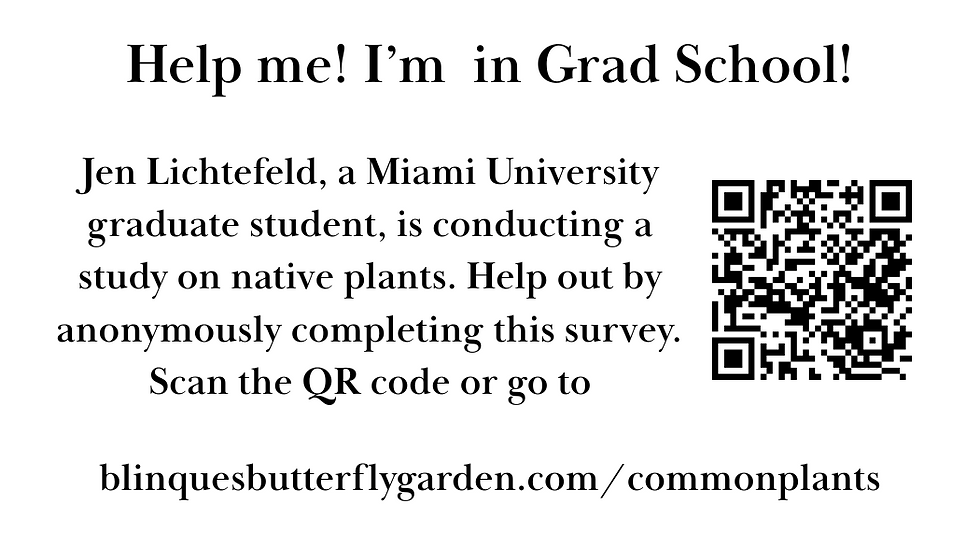
Figure A2
Images of native Ohio plants in the survey.

Top Row, Left to Right: American Bittersweet (Celastrus scandens), Common Blue Violet (Viola sororia), and Canadian Goldenrod (Solidago canadensis)
Bottom Row, Left to Right: Virginia Creeper (Parthenocissus quinquefolia), White Snakeroot (Ageratina altissima), and Yarrow (Achillea millefolium)
Figure A3
Images of native Ohio pollinators included in the survey.

Top Row, Left to Right: Unspecified bumble bee (Bombyx sp.) on American Bittersweet (Celastrus scandens), Red Pavement Ants (Tetramorium immigrans) on Common Blue Violet (Viola sororia), and an Orange-Belted bumble bee (Bombus ternarius), an Eastern Yellow Jacket (Vespula maculifrons) on Canadian Goldenrod (Solidago canadensis), and a Pandora sphinx moth (Eumorpha pandorus) on Virginia Creeper (Parthenocissus quinquefolia)
Bottom Row, Left to Right: A Clymene Moth (Haploa clymene) on White Snakeroot (Ageratina altissima), and a Painted Lady butterfly (Vanessa cardui) on Yarrow (Achillea millefolium)
Appendix B
Figure B1
Proportion of graded A responses for each question from the Control and Pollinator groups.


Comments